Grooming of Mittelschnauzer in Kiev
Professional Mittelschnauzer trimming, haircutting and care of stiff Mittelschnauzer coat in the V.O.G DOG SALON network.
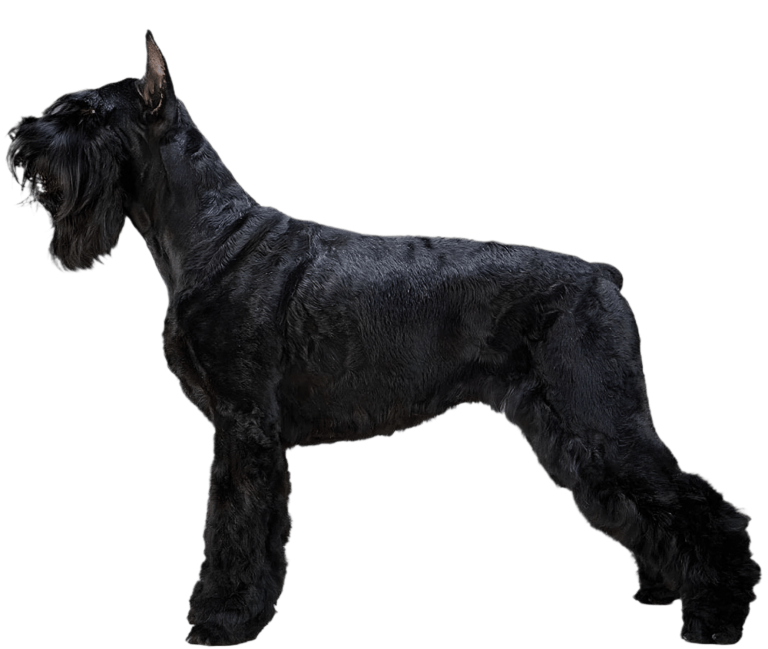
The Mittelschnauzer is a medium-sized, sturdy and well-proportioned dog with an expressive beard and thick eyebrows that form its characteristic “serious” look. Height at the withers is usually 45-50 cm, weight – about 14-20 kg. It is a hardy, energetic breed with developed intelligence and strong character. Mittelschnauzer perfectly suits active people: it is attentive, alert, quickly learns and becomes strongly attached to its owner.
The average life expectancy of a Mittelschnauzer is 12-15 years. In general, this is a healthy breed with good genetics, but like all active dogs, it needs regular care, proper nutrition and exercise control. They have a strong nervous system, get along well with family, but can be wary of strangers, which is why early socialization and proper training is important.
The Mittelschnauzer has a stiff, dense coat with a thick undercoat, which practically does not shed naturally. This means that dead hair does not fall out on its own, but remains in the coat structure, which without proper care leads to loss of texture, dullness and skin problems. The breed needs regular trimming – professional plucking of dead hair that maintains the correct stiffness and natural appearance. Regular machine trimming gradually spoils the coat structure and makes it soft.
This is why grooming a Mittelschnauzer requires experience and an understanding of the breed standard. At V.O.G DOG SALON, expert groomers work with hard-haired breeds professionally, preserving the natural coat texture, correct body shape, expressive beard and distinctive eyebrows.
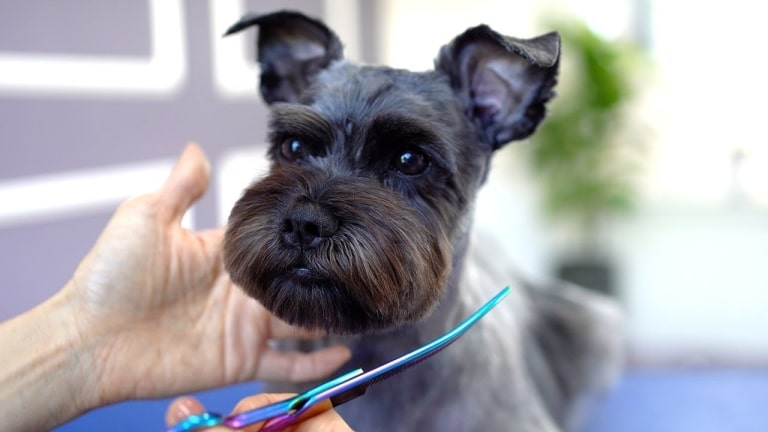
Trimming/stripping of the Mittelschnauzer (plucking of dead hair):
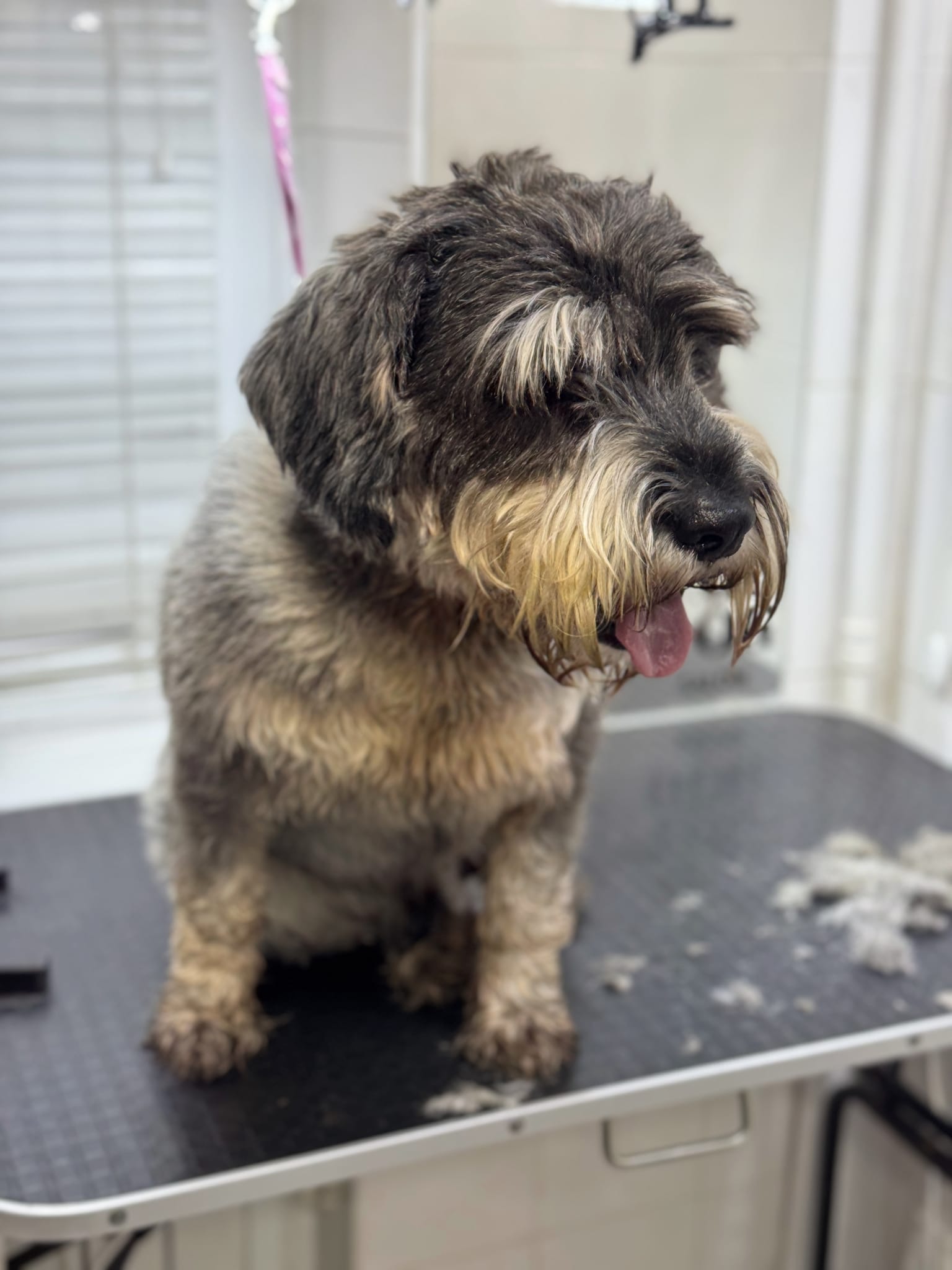
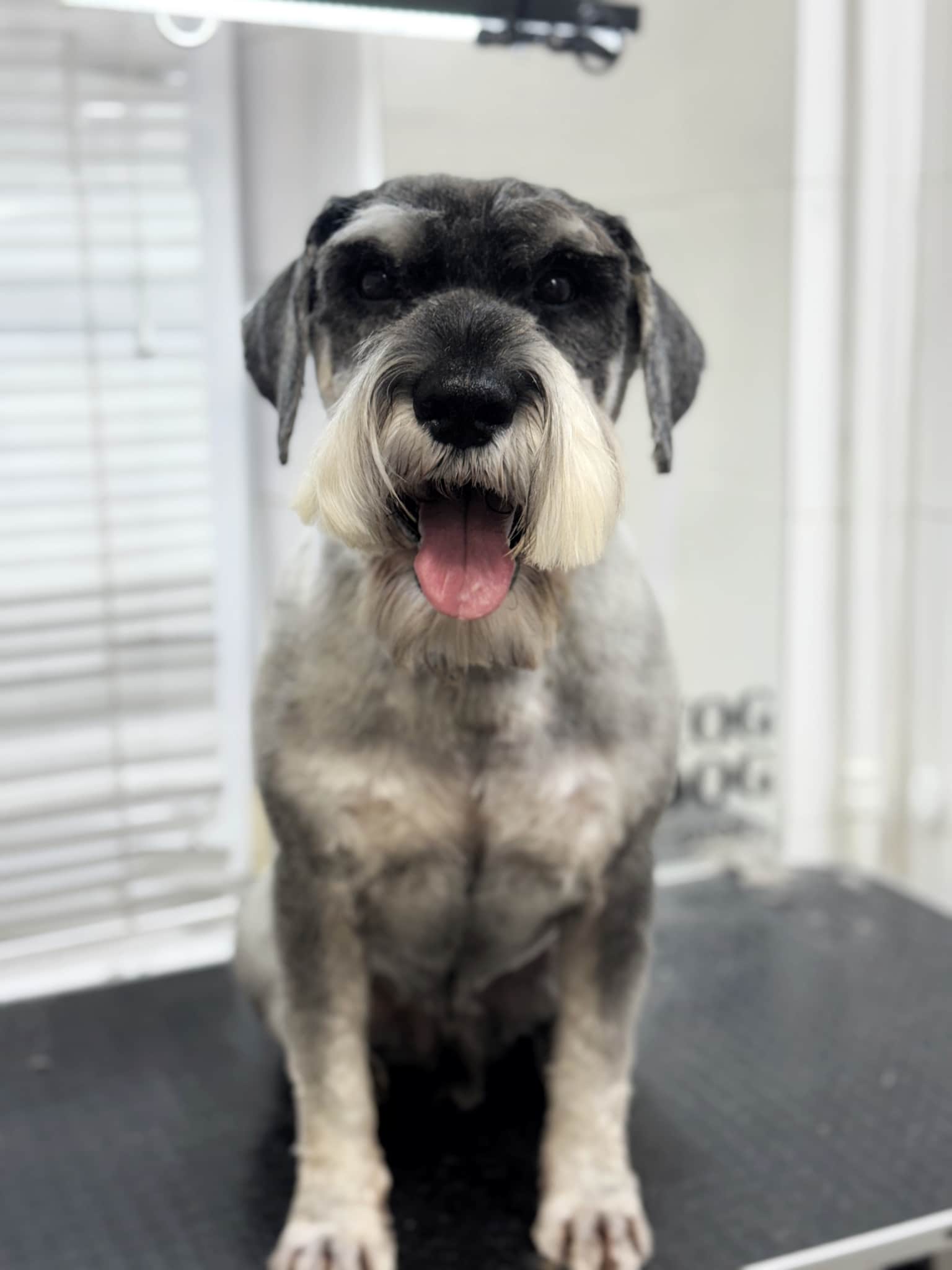
A basic procedure for the Mittelschnauzer. The stiff coat does not shed naturally, so the dead hair must be removed by hand. During trimming, the groomer gently plucks the mature hair while maintaining density, proper texture and color saturation. This allows the new stiff hair to grow properly, keeps the skin ventilated and prevents follicle blockage. Regular trimming maintains the breed's appearance and skin health.
Shaping the breed's silhouette:
After stripping the Mittelschnauzer or in the format of hygienic grooming, the body lines are modeled. The length of the hair on the legs is corrected, the chest is emphasized, and the back line is equalized. The beard and eyebrows - the breed's calling card - are formed separately. It is important to maintain the correct transitions to make the Mittelschnauzer look harmonious and proportional.
Bathing with professional cosmetics:
A stiff coat needs specially selected shampoos that do not soften the structure. Cosmetics for stiff-haired breeds are used, which cleanse the skin, but do not disturb the natural texture of the hair. After washing, the coat is properly dried and styled for growth.
Combing out the undercoat and aerating the coat:
Dense undercoat can build up and inhibit new hair growth. Gentle combing is carried out to remove excess undercoat and allow air access to the skin. This reduces the risk of irritation and overheating.
Hygienic haircutting of comfort zones:
The paws, the area between the pads, the groin area and the area under the tail are treated. This keeps it clean, reduces moisture and dirt accumulation and provides comfort in daily life.
Claw care:
Claws are trimmed to the correct anatomical length. Overly long claws alter paw placement and stress on joints. Regular monitoring helps to maintain correct posture.
Ear cleaning:
Mittelschnauzers can accumulate wax and dirt in the ear canal. Gentle cleaning with special products without traumatizing the ear canal.
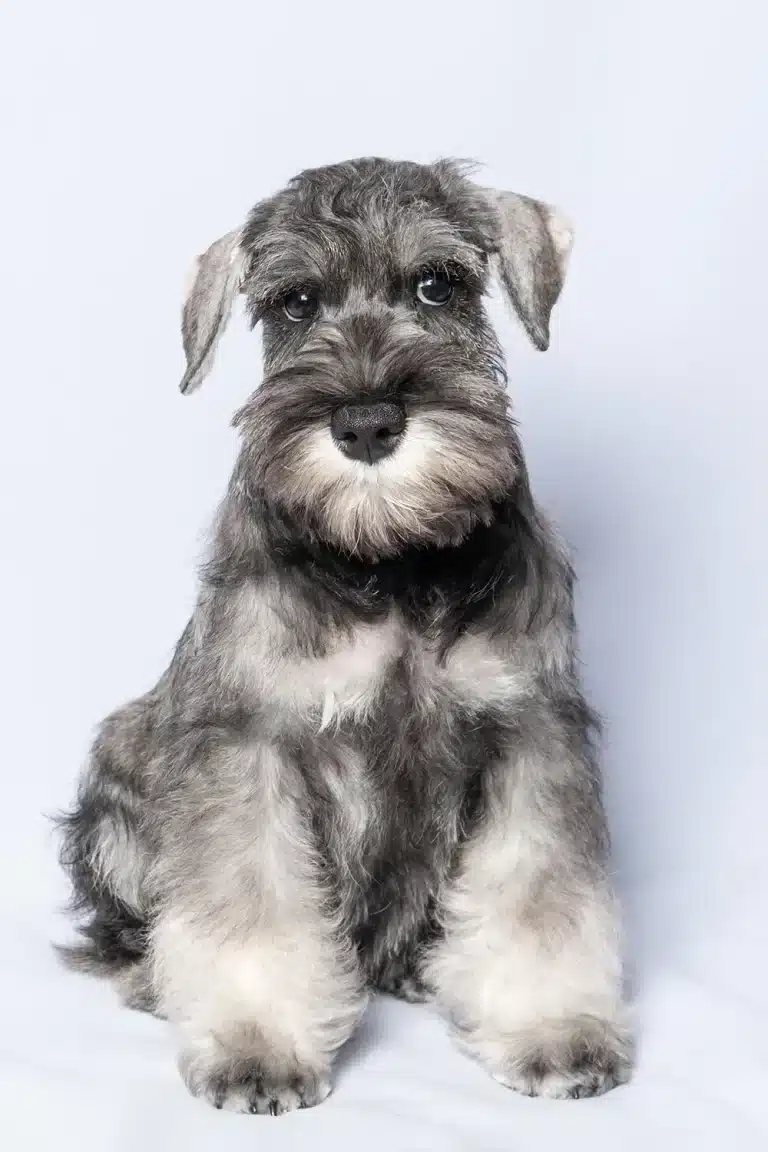
The Mittelschnauzer has a stiff pointy coat that does not shed on its own. Dead hair must be removed manually during trimming to maintain the correct texture, density and rich color. Regular shaving with a machine gradually softens the coat and changes its type. This is why professional trimming is recommended as the main method of grooming for this breed.
On average every 3-4 months. The frequency depends on the growth rate of the coat and the desired look. Regularity helps to maintain proper texture and avoid neglect.
This breed does not shed in the classic sense. Dead hair does not fall out on its own, so it must be removed during trimming. This is why grooming is a must.
The breed is considered conditionally hypoallergenic due to minimal shedding. However, it is not the coat itself that causes allergies, but the proteins of the skin and saliva, so there is no complete guarantee.
The beard needs regular washing and drying as food residue and moisture accumulate in the beard. If left untreated, odor or irritation of the skin under the coat may occur.
For example, light brushing 1-2 times a week helps prevent tangles on the paws and beard. This is not a substitute for trimming, but it keeps the coat tidy between treatments.
The first light trimming is usually done at 4-6 months of age, when the adult coat is forming. Early familiarization with the procedure helps the dog to be more accepting of future grooming.
For example, regular shaving with a machine may cause the coat to become lighter or duller. Trimming, on the other hand, helps to maintain the depth of natural color.
No. Show training requires correct trimming, correct proportions and accurate silhouette formation. Self-grooming rarely achieves the required standard.

I am Amina, and I believe that a good groomer is not only someone who skillfully uses clippers and scissors, but also a great specialist who has a deep understanding of animal behavior. I am guided by this simple definition in my work and constantly strive to improve. With your Tail, I will always find understanding during the procedures and will definitely take into account all your wishes. I also ensure that every visit of your pet will be completely comfortable for him.
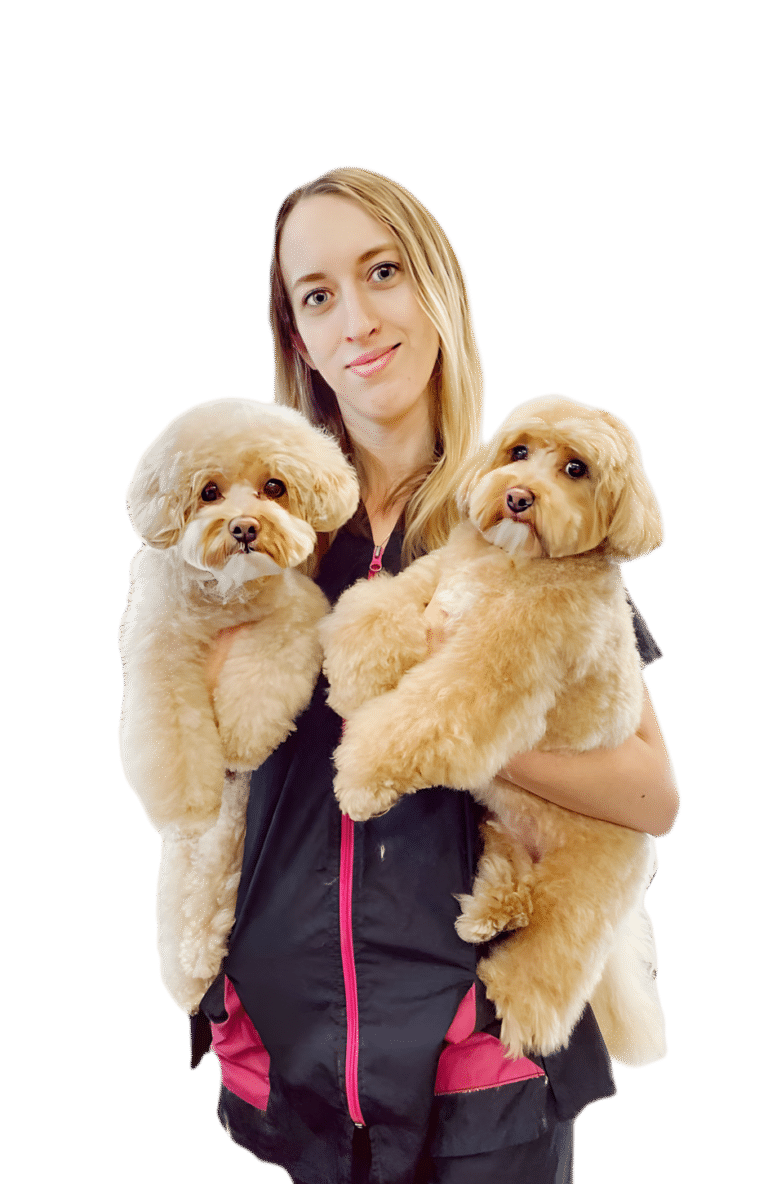
Meet Iryna – a TOP Groomer Stylist, a master with golden hands and an exceptional sense of style, who has been creating wonders in the grooming world for over 4 years!
Her favorite furry clients are the unique POMERANIANS, but she easily works with all charming breeds such as POODLES, MALTESE, MALTIPOO, COCKAPOO, CAVAPOO, YORKIES, and even the most demanding CATS.
Iryna’s professionalism is confirmed by her participation in prestigious master classes held by leading grooming experts:
- “Asian Style: Drop Coat” and “Asian Style: Volume Coat” (Anna Pozdnyakova);
- Poodle cut “Scandinavian Lion” (Oleksandra Popova);
- Jack Russell Terrier hand-stripping (Anna Ishchenko);
- Pomeranian grooming “Correct Grooming” (Yuliia Voitova);
- Bichon grooming “Asian Style” (Alina Papian).
In Iryna’s hands, your pet becomes a true work of art, where individuality, harmony, and natural beauty come first. Her secret lies in her deep understanding of every pet’s needs, endless love, and genuine care.
Iryna uses only a humane and gentle approach, ensuring your furry friend feels comfortable, calm, and surrounded by positive vibes during the whole process. That’s why every pet leaves the salon happy, beautiful, and completely satisfied!
By choosing Iryna, you’re choosing unmatched style, outstanding quality, and true artistry that brings your Loyal Companion’s unique look to life.
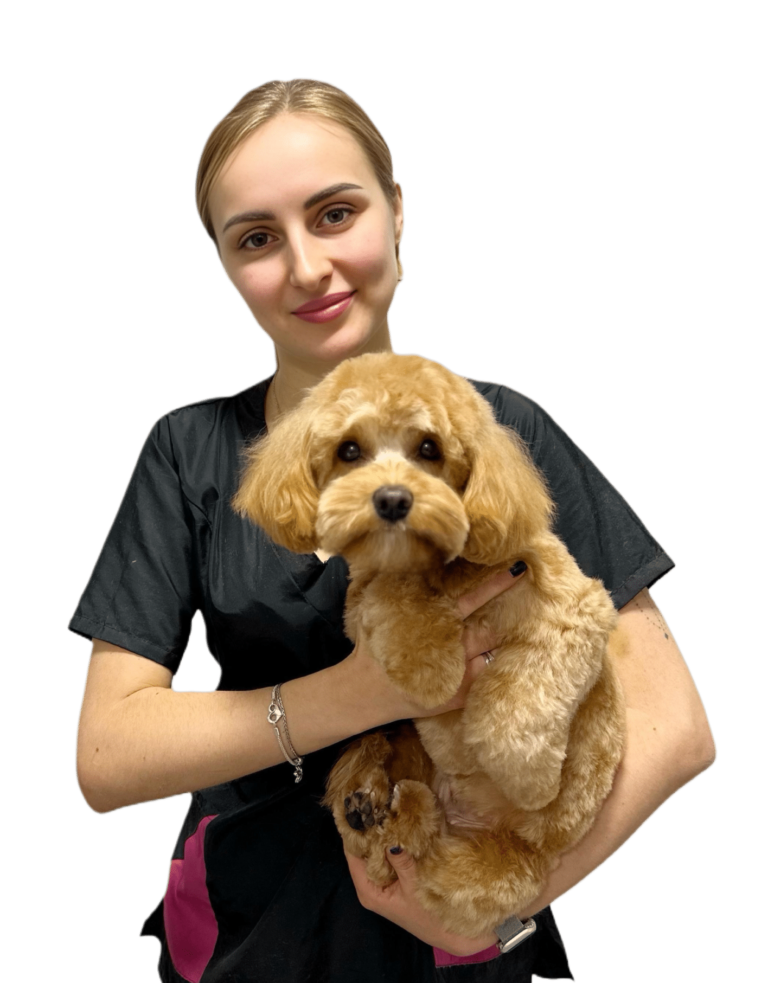
Svetlana is not just a groomer, she is a real craftswoman who turns every grooming session into a work of art. For her, caring for animals is more than just a profession; it is a passion and a calling that she has perfected over the years. Her skill and impeccable technique allow her to create individual images that emphasize the uniqueness of each Tail. Svetlana approaches each animal with great love and attention, understanding that for its owner, the Beloved is part of the family.
After Svetlana's visits, your Beloved will look well-groomed and beautiful and will shine with health and happiness. Her work is a harmony that fills the life of every client with joy. As a TOP Groomer stylist, Svitlana achieves perfection in every look. She strives not just to provide a service, but to create real masterpieces, making each visit unique and special for each client.
Her approach is based on a deep understanding of the needs and character of each animal, which allows her to create stylish and comfortable images for Tails. Svetlana takes into account all nuances: from the structure of the fur to the peculiarities of behavior, which makes the result not just beautiful, but ideal from all points of view. If you want to get the maximum possible comfort for your Pet and satisfaction from the grooming process - then you should come to Svetlana!
Kiev, Pechersk district, M. Mikhnovsky Boulevard (Friendship of Nations), 27
Kiev, Pechersk district, Lesya Ukrainka Boulevard, 14
Kiev, Solomyanka district, V. Lobanovsky Avenue, 6a
Kiev, Desniansky district, Red Kalina (Mayakovsky) Avenue, 68a
Kiev, Shevchenko district, Sholudenka Street, 14
Kiev, Darnytsky district, Knyazhy Zaton Street, 2/30
Kiev, Dnipro district, I. Kotlyarevsky (Work) Boulevard, 7
Kiev, Holosiivskyi district, 4 Seasons Residential Complex, Maksymovycha Street, 3d
Kyiv, Obolonskyi District, V. Ivasiuka Avenue, 6B (building 2)
Kiev, Shevchenkivskyi district, Shchusev Street, 4
European Street, 2a (Eurocity Residential Complex, near Vyshneve town)
Kiev, Darnytskyi district, st. Knyazhiy Zaton, 11