How to actually translate cat years into “human” years
The phrase “multiply by seven” has long been a popular joke, but it has nothing to do with cats. Cats grow up much faster than humans, especially in the first two years of life. It is this period that determines their physiological foundation: formation of organs, hormonal system, and behavioral patterns.
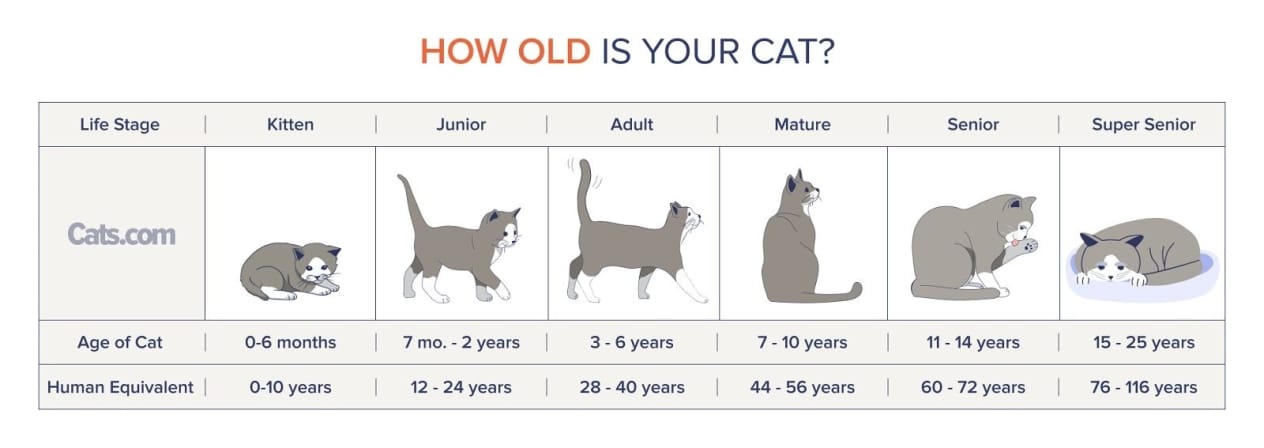
One year of a cat’s life is about 15 human years. By this point, the cat has already gone from a newborn to a sexually mature individual. At 6-8 months of age, most cats are already capable of reproduction, which biologically corresponds to human adolescence.
The second year adds about 9 more “human” years. That is, a two-year-old cat is conditionally a 24-year-old person. The body is formed, the character is stabilized, metabolism is active, and the immune system is fully functional.
After two years, everything slows down. Each subsequent year of a cat’s life is equal to about 4 human years. For example:
3 years is about 28 human years
5 years is about 36.
8 years – about 48.
10 years – approximately 56
15 years – almost 76
20 years – more than 96
These figures are not absolute, but they are much more accurate than a primitive formula. It is important to realize that this is not arithmetic – it is a reflection of the biological processes of aging: reduction of tissue elasticity, slowing down of metabolism, accumulation of micro-damage to cells.
The rate of aging is affected by living conditions. Domestic cats live an average of 14-18 years, while street cats live much less due to injuries, infections and lack of stable nutrition. Neutering, weight control, quality food and regular check-ups can actually add a few years of life.
Separately, it is worth mentioning the breed. For example, Siamese and British cats often show different average lifespans due to genetics. Large breeds sometimes age a little faster, and some long-lived cats can exceed 20 years.
What a cat’s “human age” means for care, nutrition and prevention
Age recalculation is not needed for curiosity, but to understand the body’s needs. If your cat is 10 years old, he is biologically close to a human after 55-60 years. This means that his metabolism changes, the risk of chronic diseases increases, and his joints are no longer as flexible as they used to be.
At the age of 7-8 years, the cat is already considered “mature”. During this period, it is worth switching to an adult or aging pet food with controlled phosphorus levels and a moderate amount of high quality protein. It is during this period that kidney problems, one of the most common causes of decreased longevity in cats, begin to be identified more frequently.
After 10 years of age, it is advisable to perform preventive blood tests every year. In the early stages, many diseases have no obvious symptoms. A slight decrease in activity or slight weight loss may be the first signals.
Aging in cats is not always visible outwardly. Unlike dogs, they remain flexible and neat for a long time. But internally, the body is already working differently. Muscle mass decreases, the ability to thermoregulate decreases, and hearing and vision may deteriorate.
Psychology also changes. Older cats often become calmer, more cautious, may seek warmer places, sleep longer. This is not “laziness” but biological energy conservation.
If the cat has reached 15 years, it is already a respectable age. It can be equated to a person 75+. In this period, soft beds, a stable regime, lack of stress and dental control are especially important, because dental problems directly affect the heart and kidneys.
Understanding the true age helps you not to overestimate your pet’s capabilities. If a ten-year-old cat doesn’t jump as high as he did at two years old, that’s normal. His body is working at a different pace.
The main conclusion is simple: the “human equivalent” is a tool for informed care. It allows you to see your actual biological state. And it is on this that the quality of your cat’s life depends, not just the number of years lived.