
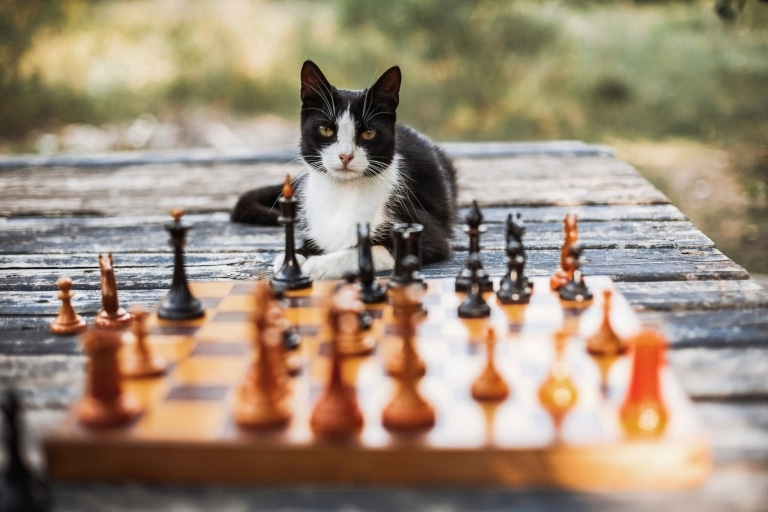
Many people believe that cats act purely on instinct: they eat, sleep, hunt, and defend their territory. However, modern research on animal behavior shows that a cat’s brain is much more complex than it might seem at first glance. Scientists are increasingly noting that cats are capable not only of following innate instincts but also of learning, remembering, and even making simple decisions.
What is instinct?
An instinct is an innate behavioral pattern that requires no learning. It is thanks to instincts that even a tiny kitten can find its mother, and an adult cat instinctively sneaks up on prey, hides in case of danger, and marks its territory.
However, instincts are only the foundation of behavior. If cats were guided solely by them, all members of the species would behave exactly the same. In reality, every owner knows how different the personalities and habits of their pets can be.


Signs of feline intelligence
One of the main signs of intelligence is the ability to learn from one’s own experience. Cats quickly memorize feeding schedules, the sound of a door opening, or even the beep of their owner’s car. Many of them can unerringly distinguish family members by their voices and footsteps.
Studies show that cats are capable of forming long-term memories. They can remember people, places, and events that evoked strong emotions for years. That is why some animals have a hard time adjusting to a move or return to old hiding spots even after a long time.
Another sign of intelligence is the ability to solve simple problems. House cats often learn to open doors, pull out drawers, or retrieve treats from interactive toys. In doing so, they use a method that has already proven successful.

Does a cat recognize its owner?
Yes. Scientists have found that cats are able to recognize their owner’s voice among other people’s. At the same time, they don’t always rush to respond, as dogs do. This behavior isn’t due to a lack of intelligence, but rather to their unique characteristics. The ancestors of domestic cats were solitary animals, so they didn’t need to constantly demonstrate their reactions to members of the group.
This is precisely why the myth arose that cats are indifferent to people. In fact, many studies show that they form a strong emotional bond with their owner and can experience stress during the owner’s prolonged absence.

Can cats be cunning?
Many owners have noticed that their cat uses various methods to get what they want. One cat might meow loudly by the food bowl, another might deliberately knock things off the table, and a third might wait patiently by the fridge, knowing that the owner will definitely notice them.
Such behavior is difficult to explain solely by instinct. It demonstrates an ability to analyze the consequences of one’s own actions and use accumulated experience to gain an advantage.
 Interesting fact
The brain of a domestic cat shares many structural similarities with the human brain. In particular, the areas responsible for emotions and information processing are organized in a similar way. This is why cats can not only learn but also form individual experiences that influence their future behavior.
Conclusion
Modern science shows that cats’ behavior is not based solely on instincts. They are capable of memorizing, learning, recognizing people, solving simple problems, and applying their own experiences in various situations. Although feline intelligence differs from that of humans or dogs, it is perfectly adapted to the lifestyle of these mysterious and independent animals. It is the combination of natural instincts and the ability to think that makes cats such unique companions.