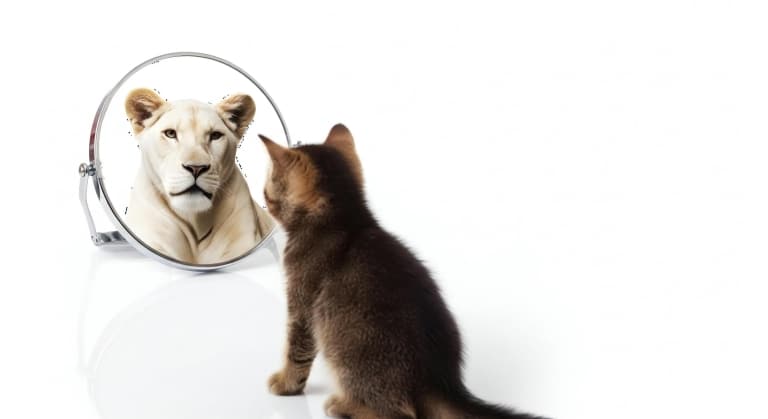
The cat looks warily at its reflection; the dog barks at the “stranger” and then tries to find it behind the mirror. After a while, most pets stop reacting to their reflection. But does that mean they’ve realized that it’s actually them in the mirror?
Mirrors have long been used to study animal behavior and self-perception. However, it turns out that the simple question of “whether or not they recognize themselves” is much more complex than previously thought.
1. What do dogs and cats see in a mirror?
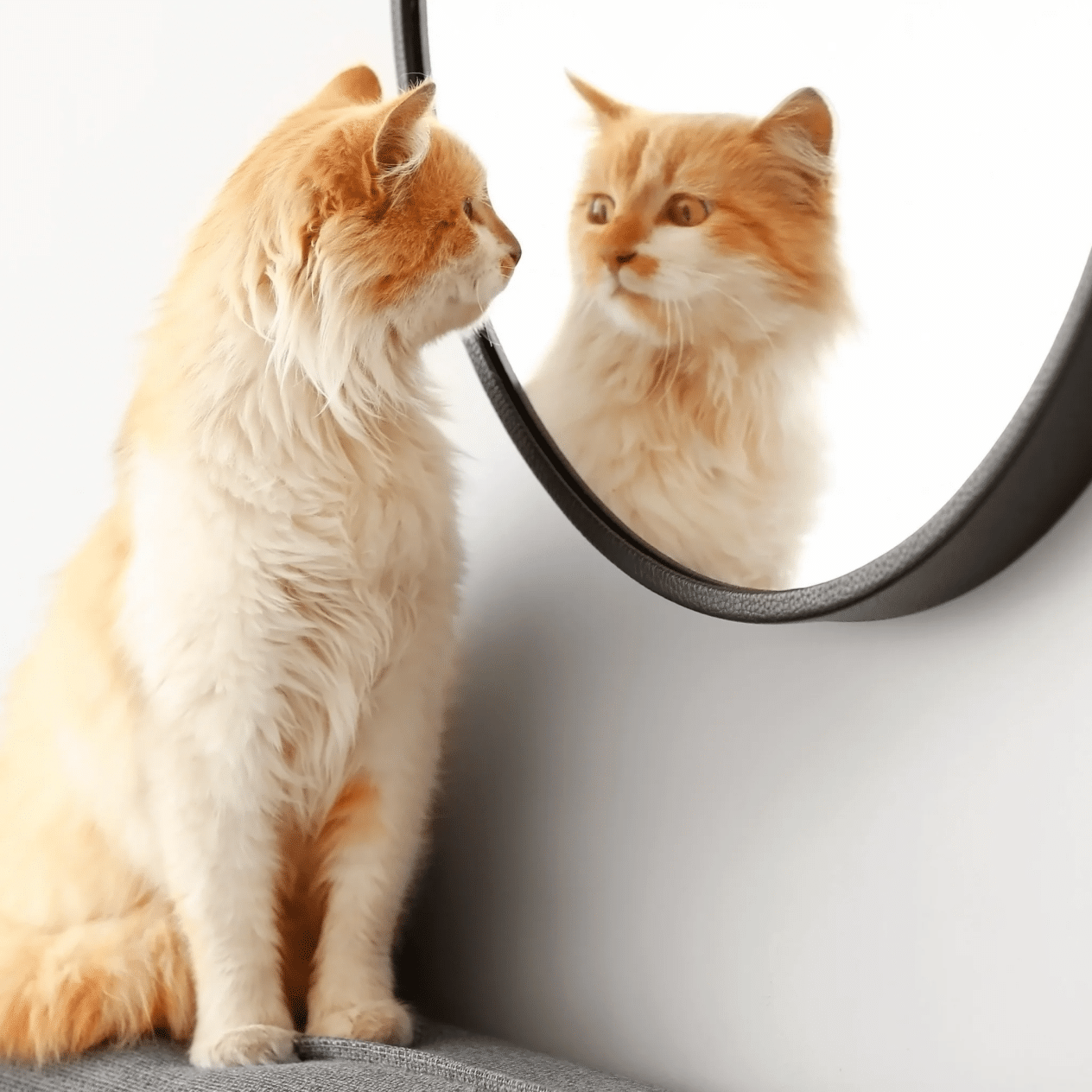
When first encountering a mirror, an animal often reacts to its reflection as if it were another creature. A dog might bark, invite the “other dog” to play, or peer behind the mirror. A cat sometimes freezes, approaches sideways, touches the glass with its paw, or tries to find an opponent behind it.
Over time, this reaction usually subsides. However, this does not yet prove that the animal has recognized itself. Perhaps it has simply realized that the creature in the mirror has no scent, does not come out, and poses no threat.
This is particularly interesting in the case of dogs, since smells are often more important to them than visual images. That is why scientists have even conducted a kind of “olfactory mirror test,” examining how dogs react to their own scent and to a modified version of their own scent. The results showed that studying the self-perception of various animals using only a regular mirror may not be sufficient.
2. What is a mirror test?
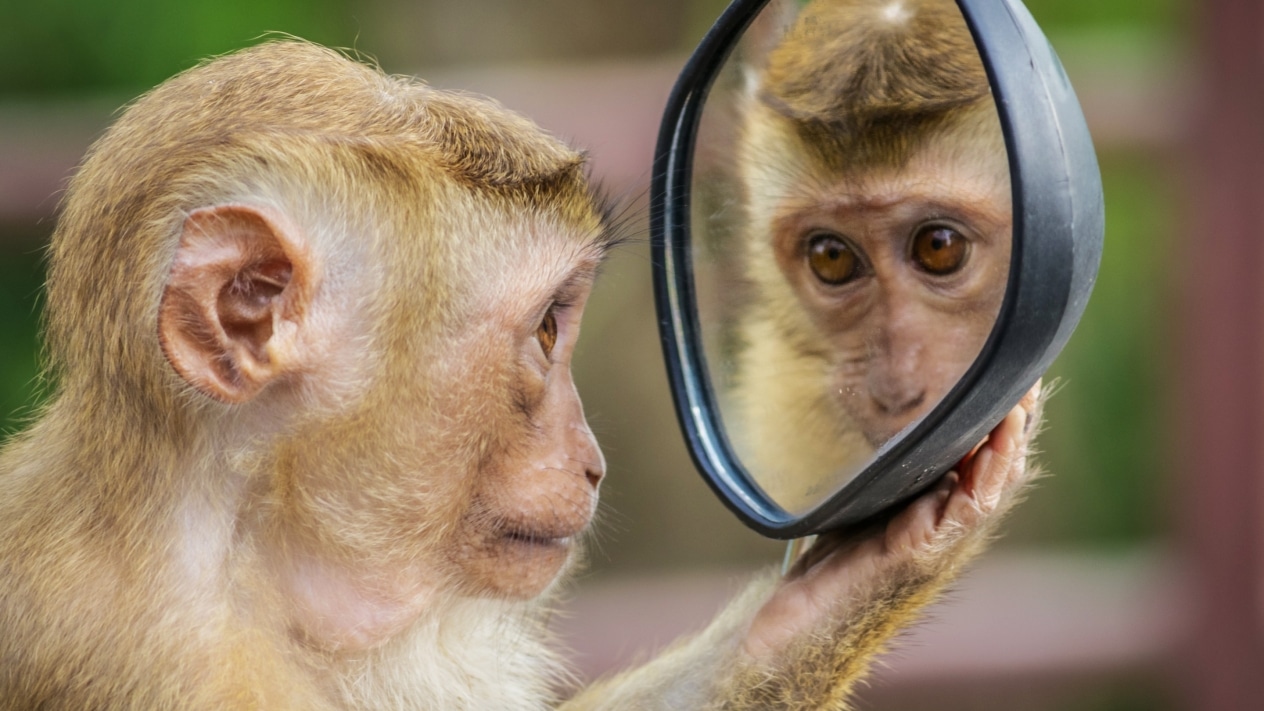
The classic mirror test is conducted in a rather interesting way. A mark is discreetly placed on the animal’s body in a spot that cannot be seen without a mirror. If the animal, while looking at its reflection, begins to touch or examine the mark on its own body, this is considered a possible sign of self-recognition.
This behavior has been observed, in particular, in some great apes, dolphins, and elephants. However, many other intelligent animals fail the test. That is why scientists debate whether a single experiment can be considered a universal indicator of self-awareness.
After all, different species perceive the world in completely different ways. For some, sight is the primary source of information; for others, it is smell, sound, or touch. An animal may be perfectly aware of the boundaries of its own body and the consequences of its actions, but simply not understand why it should look at itself in a mirror.
3. The Fish That Surprised Scientists
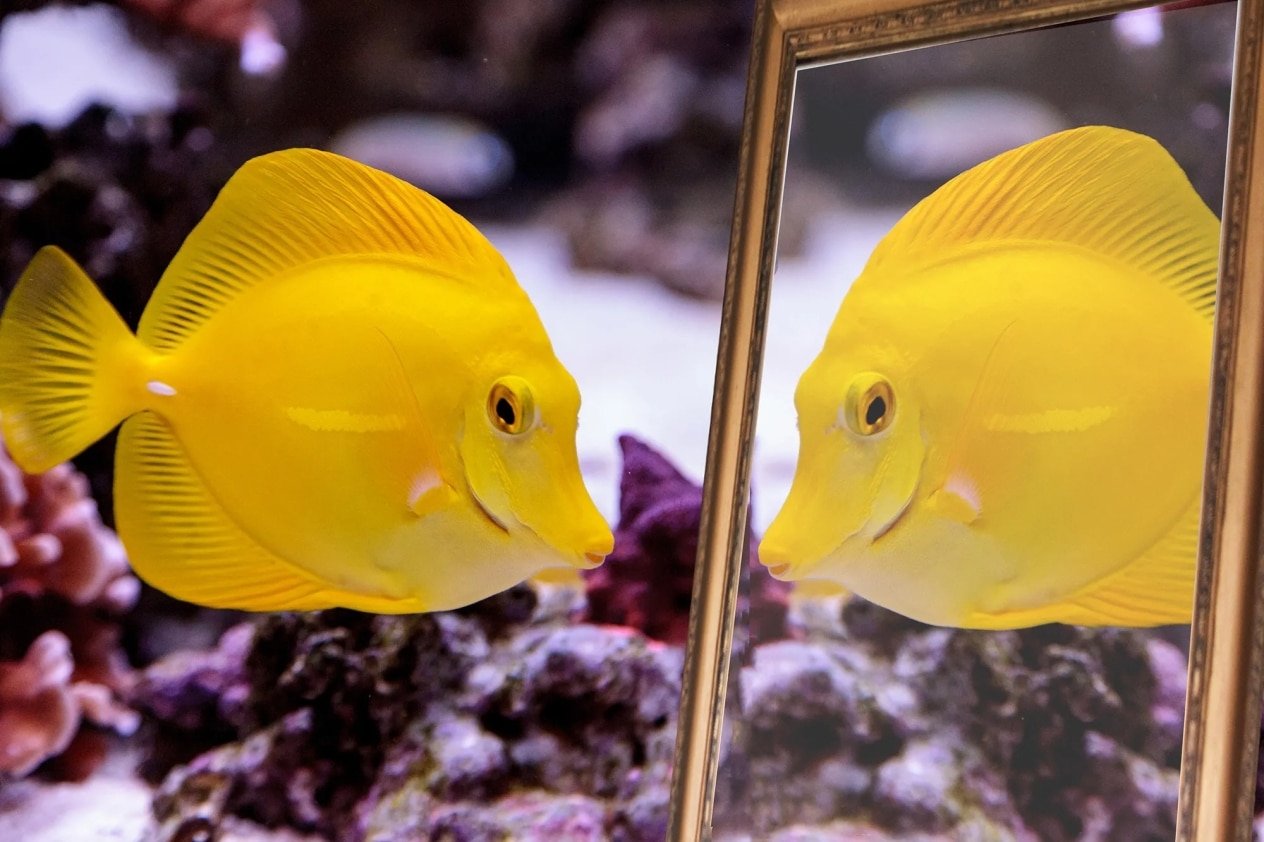
One of the most remarkable mirror experiments was conducted not with an elephant, a monkey, or a dolphin, but with a small fish—the cleaner wrasse. After being introduced to a mirror, the fish began to behave unusually in front of it, and after a visible mark was applied to their bodies, they tried to rub that area against surfaces.
The results sparked serious scientific debate. If a fish can exhibit behavior similar to passing the mirror test, does that indicate complex self-awareness? Or perhaps the test itself is far less universal than previously thought?
So when a dog looks for someone behind a mirror, or a cat tries to touch its reflection with a paw, we shouldn’t jump to conclusions about their intelligence. Perhaps the most interesting question isn’t “Does an animal recognize itself in a mirror?” but “Should it even perceive itself the same way a human does?”