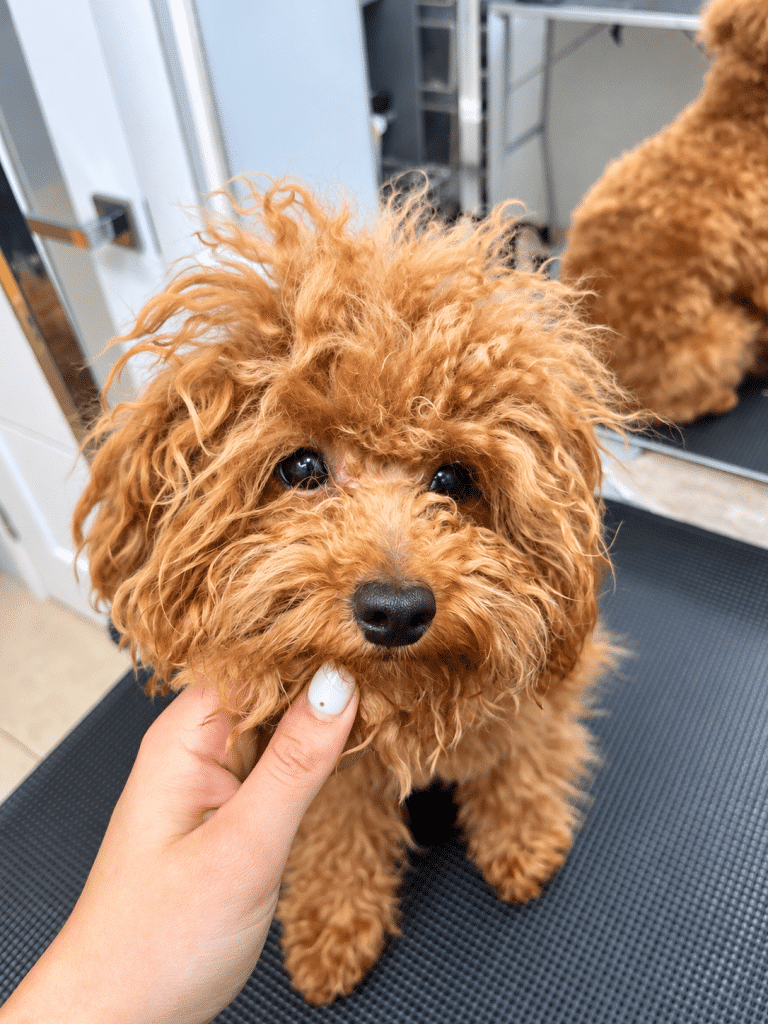
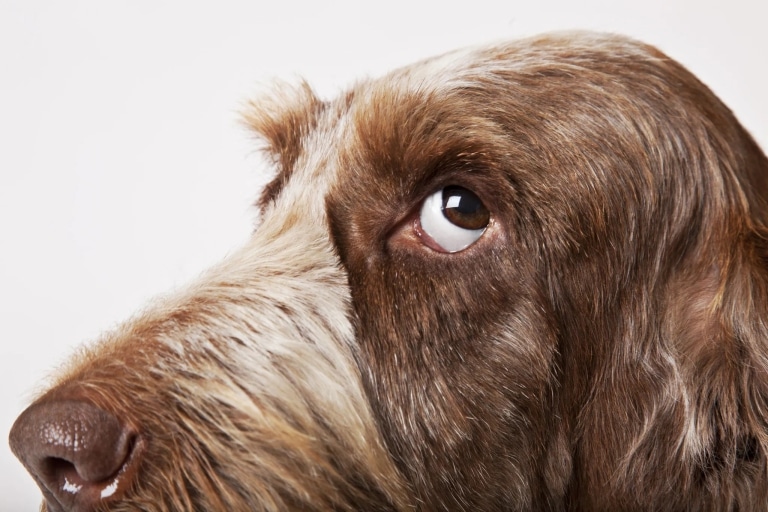
You’ve definitely seen that look. The dog sits by the table, tilts its head slightly, raises its eyebrows, and looks as if it hasn’t been fed for at least three years. A minute later, a piece of meat ends up under the table.
Coincidence? Not exactly.
Dogs have lived alongside humans for thousands of years, and during that time they’ve learned to read our gestures, eye contact, tone of voice, and even where our attention is focused with remarkable precision. But does that mean a pet can actually manipulate us intentionally?
The answer is more interesting than a simple “yes” or “no.”

Dogs can indeed be cunning—and this has been proven experimentally
The word “manipulation” is usually associated with a complex human plan: to deceive, evoke a certain emotion, and get what one wants. There is no reason to believe that dogs devise such complex psychological strategies. However, studies show that dogs are capable of changing their behavior depending on who they’re dealing with and what benefit they can gain.
In one interesting experiment, dogs interacted with two people. One was “cooperative”—he gave the dog the food it led him to. The other acted as a competitor and took the found food for himself.
There were several boxes in front of the dogs: one contained their favorite food, another contained less appealing food, and the third was empty.
And what did the dogs do?
They were more likely to lead the cooperative person to the desired food, and the competitive person to the less desirable option. The researchers called this behavior “deceptive-like behavior.”
This doesn’t mean that the dog sits in the hallway thinking, “Now I’m going to come up with a cunning plan against my owner.” Rather,they are capable of quickly learning a simple pattern:
this behavior works with one person but not with another.
Owners create their own little versions of this experiment every day.
A dog might not beg for food from someone who never gives anything from the table, but it might spend the entire meal near the chair of the most generous family member. It might fetch a ball specifically for the person who most often agrees to play. And after hearing a firm “no” from one owner, it might go check a second later to see what the other one thinks about it.
Sometimes it seems as though a dog knows not only the family’s rules but also every weak spot of each family member.
The “puppy dog eyes” are a much more interesting phenomenon than they seem
One of a dog’s most powerful tools is its face.
That famous look—when a dog raises the inner part of its eyebrows and its eyes appear larger and sadder—intrigued scientists so much that they began studying the facial anatomy of dogs and wolves.
In a 2019 study, researchers discovered significant differences in the muscles around the eyes of dogs and wolves. In dogs, the muscle associated with the intense raising of the inner part of the eyebrows was much more pronounced. The authors suggested that this feature may have developed during the process of domestication and interaction with humans.
Simply put, over many generations, humans may have unconsciously favored dogs whose faces elicited a stronger emotional response in them.
But there is an even more interesting fact.
A study of eye contact between dogs and humans revealed a link between prolonged eye contact and changes in oxytocin levels—a substance associated with social bonding. The authors described a positive cycle of interaction: a dog’s gaze intensifies the owner’s response, and further interaction strengthens the bond between them.
So when a dog looks intently into your eyes, and a few seconds later you say, “All right, here’s a little piece,” you may be witnessing the result of a very long history of coexistence between the two species.
Does the dog make this gaze consciously, thinking, “I’ll raise an eyebrow now, and the human will give in”?
Science provides no basis for asserting exactly that. But dogs are excellent at learning to repeat behaviors that yield results.
If a certain look has resulted in a treat ten times, the eleventh attempt is unlikely to be a coincidence.

Most often, a dog “manipulates” us because we’ve taught it to do so
Let’s imagine a common situation.
A dog approaches its owner and touches them with its paw. The person laughs and pets the dog. The next day, the paw appears again.
A week later, the dog is already placing its paw on the person every time it wants attention.
Another situation: the dog barks at the door. The owner opens the door immediately. Over time, the barking becomes like a button to summon a personal doorman.
Another classic: the dog brings a toy; the person puts aside what they’re doing and throws it. After a while, the pet knows exactly how to start the game.
This is the most interesting paradox: we think we’re training the dog, but at the same time, the dog is learning to control our reactions.
Studies show that dogs are sensitive to a person’s state of attention and can change their behavior depending on whether the person is looking at them and what the person can see. At the same time, scientists interpret these abilities with caution: some of this behavior may be explained not by complex “mind reading,” but by learning from experience and paying attention to familiar cues.
That is why two dogs in different families may develop completely different methods of getting what they want.
- One brings a toy.
- Another rests its head on its owner’s lap.
- A third sits by the refrigerator and silently looks at its owner.
- And a fourth first goes to one family member, gets turned down, and then, without any hesitation, moves on to the next.
The dog constantly observes the consequences of its actions. What worked? What got its owner’s attention? Which behavior caused the door to open? What sound made the person get up from the couch? Who in the family most often shares food?
And gradually, an entire system of communication takes shape.
So who is manipulating whom?
A dog can indeed use behaviors that help it get what it wants. It is capable of taking human attention into account, distinguishing between beneficial and unbeneficial partners, and repeating actions that have previously yielded results. But to call this cold-blooded human manipulation would be an exaggeration.
Most often, what we’re seeing is a combination of natural social awareness, a capacity for learning, and a wealth of experience living alongside humans. So the next time a dog looks at you with the saddest eyes in the world and you suddenly give it the coziest spot on the couch, stop and think:
“Maybe it isn’t you who’s been raising the dog all these years. Maybe all this time, it has been raising you, little by little.”