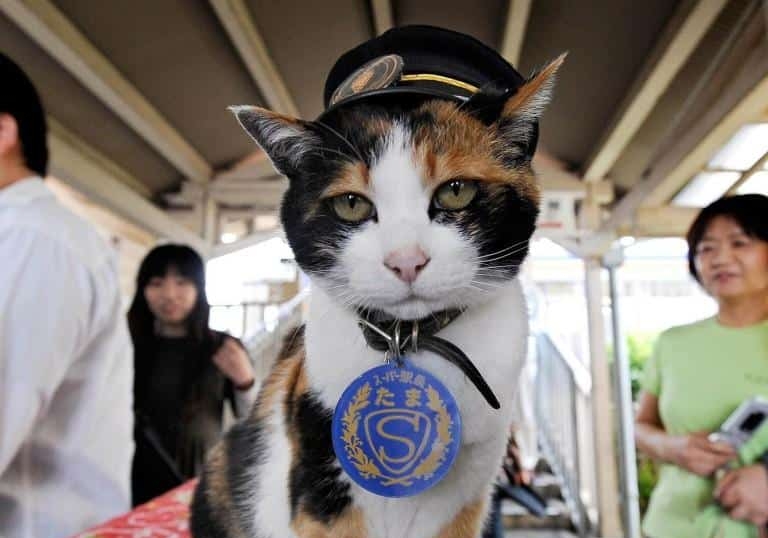
At Kishi Station in Wakayama Prefecture, Japan, the station manager could often be found near the ticket turnstile. She liked to sit there while passengers boarded the train and got off at the platform. She wore a tiny uniform cap on her head, and her name was Tama. The calico cat became so famous that people began traveling to the terminal station specifically to meet her.

Tama at the celebration of the second anniversary of her appointment, 2009. Photo by Takobou, Wikimedia Commons, CC BY 2.5.
How a Cat from a Small Shop Got a Job on the Railroad
Kishi is the terminal station of the small Kishigawa Railway line, which connects the cities of Wakayama and Kinokawa. The line opened back in 1916, but over time, ridership declined. In 2004, the operator at the time decided to shut it down. Local residents campaigned to save the railway, and local authorities set out to find a new operator. In 2006, the Wakayama Electric Railway took over the line.
While the new operator was renovating the station, an issue arose that hardly anyone had anticipated during the change of operator. Next to Kishi Station stood a small shop whose owners cared for three cats. Due to the redevelopment of the area, their little house had to be moved. The shop owner approached railway manager Mitsunobu Kojima and asked if the cats could stay at the station.
Kojima came to meet the cats. As the company later recounted, he was struck by the serious gaze of the tri-colored Tama. He decided to appoint her as station manager and the other two cats as her assistants. So, in January 2007, Tama got a job with the railroad, and Kishi became the station manager—a position that would soon be recognized throughout Japan.
Tama even had a work schedule. She spent six days a week at the station and had Sundays off. Her favorite spot was the ticket turnstile, where passengers passed by. That was the easiest place to see the stationmaster doing her usual job—watching people come and go.

Why Passengers Started Riding to Tama
News of the cat, who had been given a uniform cap by the railway, quickly spread throughout Japan. People who previously had no reason to visit Kishi Station began arriving there. Eventually, Tama became known abroad as well. For her fans, a trip on the small local line became an opportunity to see the cat they already knew from photographs.
In 2008, the prefectural governor awarded Tama an honorary knighthood for her contribution to the development of tourism. In a photo from the second anniversary of her appointment, both her cap and her medal are visible. And in 2013, the railway company went even further and granted Tama the honorary title of acting president. And so, the cat from the little house near the shop found herself at the helm of a company whose manager had once been asked simply to find her a spot at the station.
The most noticeable change occurred in 2010, when the station building was renovated. The roof was given two pointed projections resembling cat ears, and the round windows looked like eyes. You could make out the cat’s face from the street, even before stepping inside.
Behind the door, Tama’s own office awaited her. Over the course of a few years, the question “Where will the cats live now?” had changed so much that a separate room in the new building was set aside for one of them. And the building itself, designed with her fame in mind, retained its feline features even after Tami was gone.

Kishi Station after renovation, 2010. Photo by hirorin0505, Wikimedia Commons, public domain.
How Nitama took over the Sunday shift—and then the position
While Tama was still alive, another calico cat—Nitama—appeared at the station. Her name means “Tama the Second.” At first, she filled in for the station manager on Sundays. So even on Tama’s days off, passengers could find the cat on duty at Kishi.
In 2015, Tama passed away. The company posthumously awarded her the title of honorary station manager for life and transferred the position to Nitama. A small shrine was set up on the platform in Tama’s honor—in the very same spot where people had come for years to see her.
When you look at photos of Tama, it’s easy to see why her cap was so memorable. But the station itself tells her story best. At first, there was a small house next to it, which had to be moved. Later, the new building featured an entire office for the cat, and cat ears were added above the entrance. Even today, you can tell at Kishi Station who the station owes its appearance to.